The data is telling
more than one story.
Human health, vectors, and environmental conditions each reveal part of the picture. One Health Atlas helps epidemiologists connect those perspectives and decide what deserves a closer look.
Our opening example: Lyme disease.
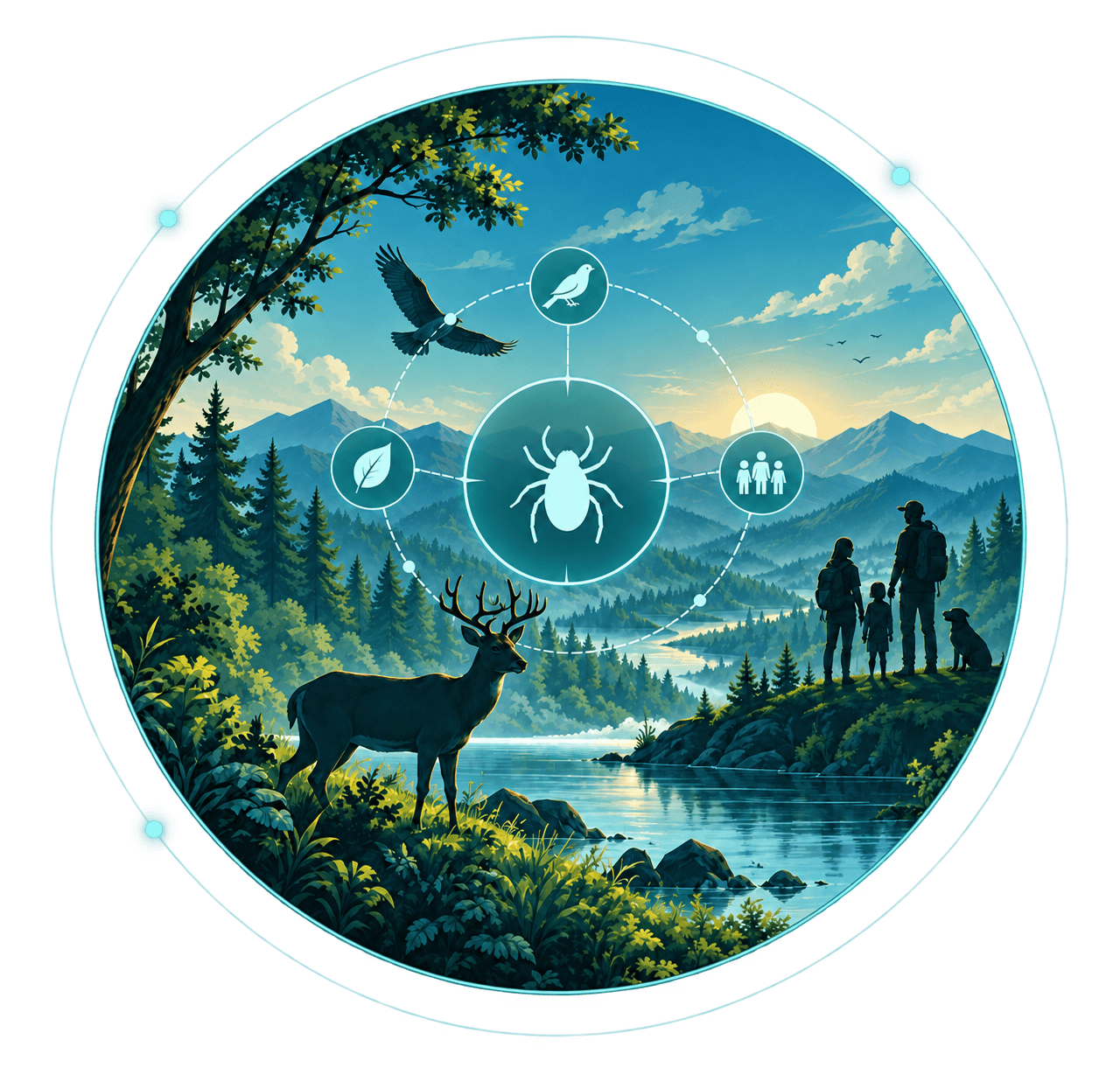
When human cases, tick data, and environmental signals do not line up, what should public health do?
Reported illness, tick observations, and environmental conditions can point in different directions.
That difference is a reason for a closer look. It does not, by itself, show underreporting, local transmission, or personal risk.
Reported cases show part of the human signal
Reported Lyme disease cases show where illness was recognized and recorded.
They do not show every infection, where exposure happened, or that a place without reports is free of disease.
A missing report is not a count of zero.
Ticks and pathogens answer different questions
Tick observations record where vectors have been found. Pathogen testing, when a program has done it, records what was detected in the samples that were tested.
Finding a tick is not the same as finding a pathogen. Neither result on its own shows that a pathogen is established or that people are being infected locally.
Place and community fill in the setting
Landscape, season, and access to care describe the setting around human and vector signals. They are context, not proof that one condition caused another.
One Health is the practice of reading human health, vectors, and the environment together.
Every stream has a source and a limit
The streams Atlas is meant to hold — published human surveillance, tick and pathogen observations, and community context — each come from their own source, place, and time window.
This introduction does not state a year, a count, or a coverage rate. Unknown is not zero.
A pattern is a reason to inspect the source, not a forecast or a finding that one thing caused another.
Look across the streams, then decide where to look closer
Atlas is where those streams can be inspected together before deciding what deserves a closer look.
The professional workspace is for public-health epidemiologists doing that review. It does not turn disagreement between streams into a risk score or an outbreak call.
Built for public-health epidemiologists